
The Finance Structure Problem Most Nonprofits Miss
May 14, 2026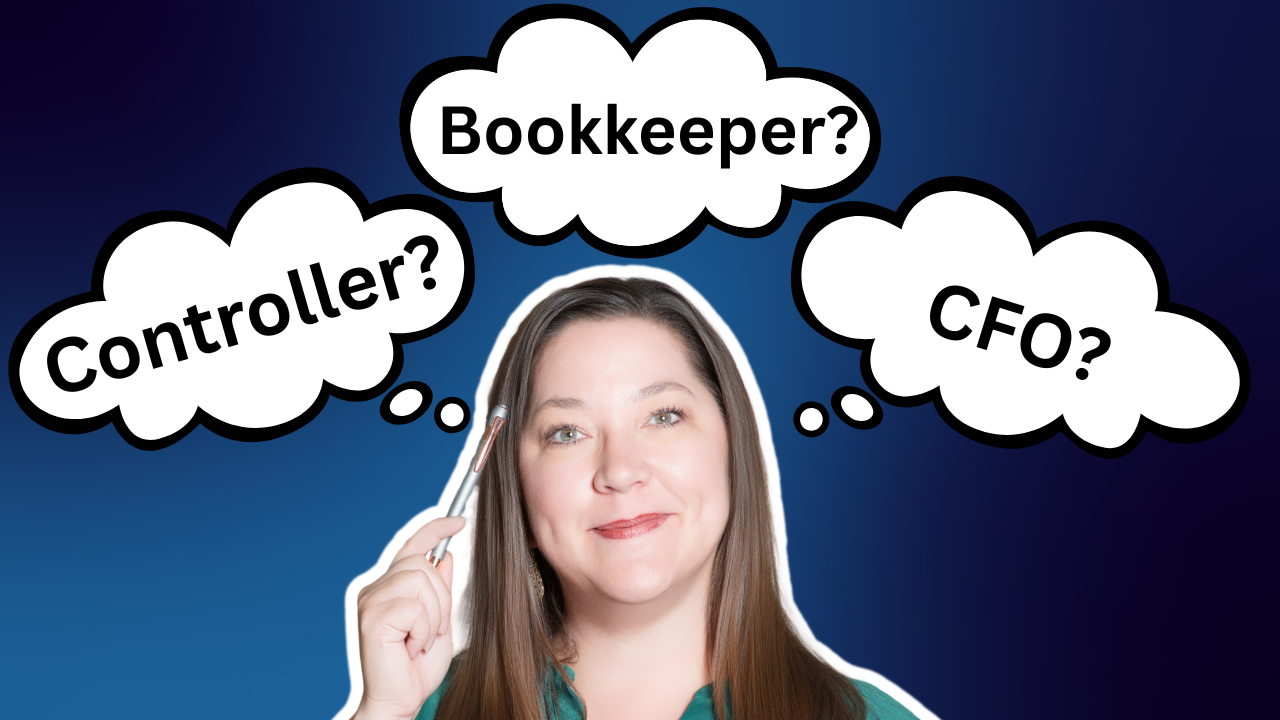

Bookkeeper vs Controller vs CFO: What Growing Nonprofits Actually Need
Most nonprofits don’t have a finance problem.
They have a finance structure problem.
As organizations grow, revenue increases. Programs expand. Complexity multiplies. But the financial structure often stays exactly the same.
Eventually leadership starts saying things like:
-
“We don’t really know how we’re doing financially.”
-
“Why are we always surprised by cash flow?”
-
“Why does budgeting feel reactive instead of strategic?”
That’s not a people problem.
It’s a structure problem.
Let’s walk through the three primary financial roles most growing nonprofits move through: bookkeeper, controller, and CFO — and how to recognize when it’s time to move to the next level.
The Bookkeeper: The Foundation
The bookkeeper is the foundation of your financial operations.
This role is responsible for day-to-day transactions. Bookkeepers:
-
Record deposits
-
Pay bills
-
Reconcile bank accounts
-
Generate basic financial reports
They are excellent at maintaining the data.
But here’s the key distinction: bookkeeping is focused on the past.
It answers questions like:
-
How did last month go?
-
What was our revenue?
-
What were our expenses?
That work is absolutely essential. Without it, you don’t have reliable financial records.
But it’s rear-view mirror work.
Once your organization approaches the $1 million range, complexity usually begins to outpace what a bookkeeper alone can manage. Multiple funding sources, restricted gifts, grant reporting, payroll expansion, and internal controls begin demanding more oversight and interpretation.
That’s when many nonprofits add the next layer.
The Controller (or Accountant / Finance Director): Accuracy and Interpretation
In some organizations, this role may be called a controller, accountant, or finance director. The title varies, but the function is similar.
This role is more analytical and supervisory.
The controller typically:
-
Oversees the accuracy and timing of financial reports
-
Strengthens internal controls
-
Manages compliance
-
Interprets financial results
-
Assists with budgeting
If the bookkeeper captures the data, the controller explains it.
This role answers:
-
Are the numbers accurate?
-
Are we compliant?
-
Are reports prepared correctly?
A strong controller is invaluable. They ensure integrity in the financial process and build reliability into reporting.
But even a strong controller is still primarily focused on the present and the recent past.
Accuracy. Compliance. Reporting.
They are managing the engine.
But they are not necessarily charting the destination.
The CFO: Strategic and Forward-Looking
The Chief Financial Officer operates at an executive level and brings a forward-looking perspective to the organization.
A CFO:
-
Engages regularly with the Executive Director or Senior Pastor
-
Works directly with the board
-
Performs scenario planning and financial modeling
-
Advises on staffing decisions
-
Guides debt strategy
-
Manages investment decisions
-
Develops long-term sustainability plans
The CFO is looking through the windshield, not the rear-view mirror.
They help answer questions like:
-
Can we afford to hire next quarter?
-
How long could we sustain operations if revenue dipped?
-
Should we take on debt — or would it devour mission?
-
Are we structured to fund the vision five years from now?
When your organization reaches $1–$3 million in annual revenue — especially with multiple funding streams, restricted funds, grants, campuses, or programs — this level of thinking becomes critical.
And here’s something important: boards often begin expecting CFO-level insight long before the budget can support a full-time CFO.
That’s where tension begins.
The Leadership Gap Most Nonprofits Experience
I call this the leadership gap.
You’ve outgrown a bookkeeper. You may even have a controller. But you’re not yet large enough — or financially ready — to hire a full-time CFO.
And yet the complexity is real.
You’re facing:
-
Capital decisions
-
Staffing expansions
-
Debt considerations
-
Revenue diversification
-
Multi-site growth in churches
-
Larger grant compliance requirements
The stakes are higher.
Without forward-looking financial leadership, organizations often begin making reactive decisions instead of strategic ones. Not because they’re careless, but because no one is consistently sitting at the table thinking three to five years ahead financially.
This is when structure matters most.
The Bridge: Fractional CFO Services
This is exactly where a Fractional CFO makes sense.
Instead of hiring a full-time executive-level CFO — which may not be financially feasible — you engage CFO-level strategy on a fractional basis.
That means:
-
Executive-level financial thinking
-
Modeling and scenario planning
-
Board-level reporting clarity
-
Strategic financial leadership
Without the cost of a full-time executive salary.
Our team of fractional nonprofit CFOs works exclusively with churches, nonprofits, and private schools. This is all we do.
We step into that growth gap and provide the strategic financial leadership that bridges the space between controller-level reporting and full-scale CFO infrastructure.
Because growth without financial strategy creates fragility.
But growth with clarity fuels mission.
If you’re wondering whether your organization has outgrown its current financial structure, that’s a great place to start a conversation.
Visit https://www.thrivenonprofit.com/you to start the conversation. We would be honored to help you align your financial leadership with your mission and build the structure that supports sustainable growth.
Sign Up to Receive Financial Tips in Your In Box
We hate SPAM. We will never sell your information, for any reason.